 Nepal
Nepal
Kathmandu University
Nepal
Kathmandu University (KU) is an autonomous, not-for-profit, self-funding public institution established by an Act of Par...
View UniversityNepal Nepali: नà¥à¤ªà¤¾à¤² [nepal]), officially the Federal Democratic Republic of Nepal (Nepali: सà¤à¥à¤à¥à¤¯ लà¥à¤à¤¤à¤¾à¤¨à¥à¤¤à¥à¤°à¤¿à¤ à¤à¤£à¤¤à¤¨à¥à¤¤à¥à¤...
Intake
Primary intakes generally open in September/October and in select universities for February/March sessions.
Living Cost
Living costs vary by city and lifestyle. Students should budget for hostel, food, insurance, transport, and local essentials.
Popular Courses
MBBS, Nursing
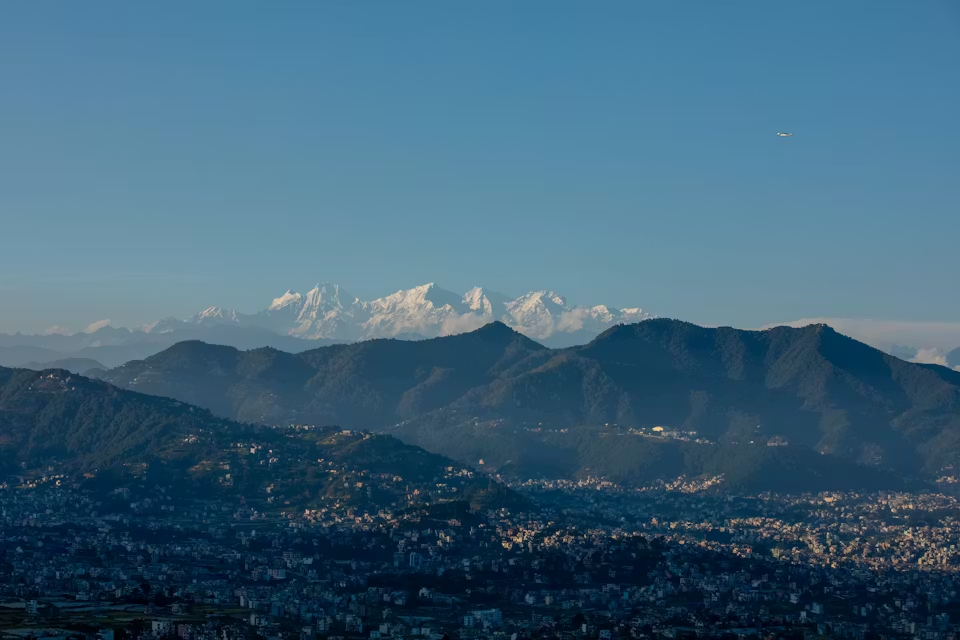
Nepal Nepali: नà¥à¤ªà¤¾à¤² [nepal]), officially the Federal Democratic Republic of Nepal (Nepali: सà¤à¥à¤à¥à¤¯ लà¥à¤à¤¤à¤¾à¤¨à¥à¤¤à¥à¤°à¤¿à¤ à¤à¤£à¤¤à¤¨à¥à¤¤à¥à¤° नà¥à¤ªà¤¾à¤²),[18] is a landlocked country in South Asia. It is mainly situated in the Himalayas, but also includes parts of the Indo-Gangetic Plain, bordering Tibet of China to the north, and India in the south, east, and west, while it is narrowly separated from Bangladesh by the Siliguri Corridor, and from Bhutan by the Indian state of Sikkim. Nepal has a diverse geography, including fertile plains, subalpine forested hills, and eight of the world's ten tallest mountains, including Mount Everest, the highest point on Earth. Nepal is a multi-ethnic, multi-lingual, multi-religious and multi-cultural state, with Nepali as the official language. Kathmandu is the nation's capital and the largest city.
Study MBBS in Nepal in English medium at some of the best MBBS College in Nepal. MBBS Course in Nepal from Medical Colleges in Nepal for Indian students recognized by MCI are valued in India. However, choosing the right college is a challenge for Indian students.
Kathmandu UniversityStudents should meet minimum academic criteria in Physics, Chemistry, and Biology/Maths based on chosen course, plus country-specific entry norms.
Shortlist universities, submit application and academic documents, receive admission letter, complete visa formalities, and plan departure.
Visa support includes document checklist verification, interview guidance, submission assistance, and pre-departure preparation.
Kathmandu University (KU) is an autonomous, not-for-profit, self-funding public institution established by an Act of Parliament in December 1991. It is an institution of higher learning dedicated to maintaining the standard of academic excellence in various classical and professional disciplines. The mission statement of the University is âto provide quality education for leadershipâ. The vision is âto become a world-class university devoted to bringing knowledge and technology to the service of mankindâ. The University aspires to serve the nation by fulfilling the needs of the society through the motto of taking knowledge and skills âfrom the campus to the community.â The Universityâs broadly perceived signature features include autonomous administration, financial self-sustenance, regular maintenance of the academic calendar, sustained trust of the international academic community, optimum contact between faculties and students and student-friendly environment, among others. Similarly, the Universityâs graduates are widely known for attributes such as substantive exposure to the industry and the community, research competence, technological literacy, moderate to high-level communicative competence, teamwork and leadership spirit and global compatibility. The Senate is the apex body of the University. It comprises University authorities, dignified educationists, government secretaries, donors, mayors of local municipalities, teacher representatives, student representative, and representatives from affiliated institutions and industries. The Prime Minister, who is the Chancellor of the University, chairs the Senate. The Minister of Education is the Pro-Chancellor. The Executive Council and Academic Council develop internal policies and programs to run the University. The Universityâs Board of Trustees, which comprises renowned personalities including the founding fathers, is entrusted with the responsibilities of advising long-term plans and generating and managing of resources. The University operates through seven Schools: (i) School of Arts, (ii) School of Education, (iii) School of Engineering, (iv) School of Law, (v) School of Management, (vi) School of Medical Sciences and (vii) School of Science. At present, the University offers more than 140 long-term and short-term academic programs and courses from intermediate to Ph.D. levels. As of December 2018, the University has produced 28,794 graduates. Student fees cover 60% in KUâs financial management. The same percentage of student fees goes into salary and allowances. Other sources cover 40%, whereas the government support is 10%. A total of about 10% of the students studying in the University at various levels receive scholarships apart from educational loan facilities and other sponsoring schemes from different organizations. KU runs academic programs most of which are credited for being introduced for the first time in the country. Business Administration, Pharmacy, Environmental Science, Biotechnology, Human Biology, Mechanical Engineering, Computer Engineering, Electrical and Electronics Engineering, Geomatics Engineering, Development Studies, Social Work, Technical Education, Media Studies, Civil Engineering with Specialization in Hydropower, Landscape Management and Heritage studies, Doctor of Medicine (DM) in Gastroenterology, DM in Neurology and MS by Research in Glaciology count among the pioneering programs in Nepal. The University marked the year 2016 as its Silver Jubilee Year. On the occasion of the Silver Jubilee celebrations, Prof. Dr. Ram Kantha Makaju Shrestha, the then Vice-Chancellor, brought forward a vision document, Silver Jubilee Initiatives â Vision 2030, which pledges thrust for quality, innovation, equity, identity, impact and global engagement. These initiatives, founded on the Universityâs key achievements for 25 years in quality education, will remain instrumental towards achieving the status of a world-class university.
Living costs vary by city and lifestyle. Students should budget for hostel, food, insurance, transport, and local essentials.
Primary intakes generally open in September/October and in select universities for February/March sessions.
Nepal
Nepal
Kathmandu University (KU) is an autonomous, not-for-profit, self-funding public institution established by an Act of Par...
View University
Nepal
Nepal
On 18th October 1992, a historic agreement was signed between the-then His Majestyâs Government of Nepal and the Manip...
View UniversityFAQs are being updated for this destination.

Unlike studying Medicine in Europe, study in medicine in the U.S.A. generally begins after completion of four years of u...

Studying MBBS in UK is the most competitive Course in the United Kingdom. Indian students, as well as international stud...
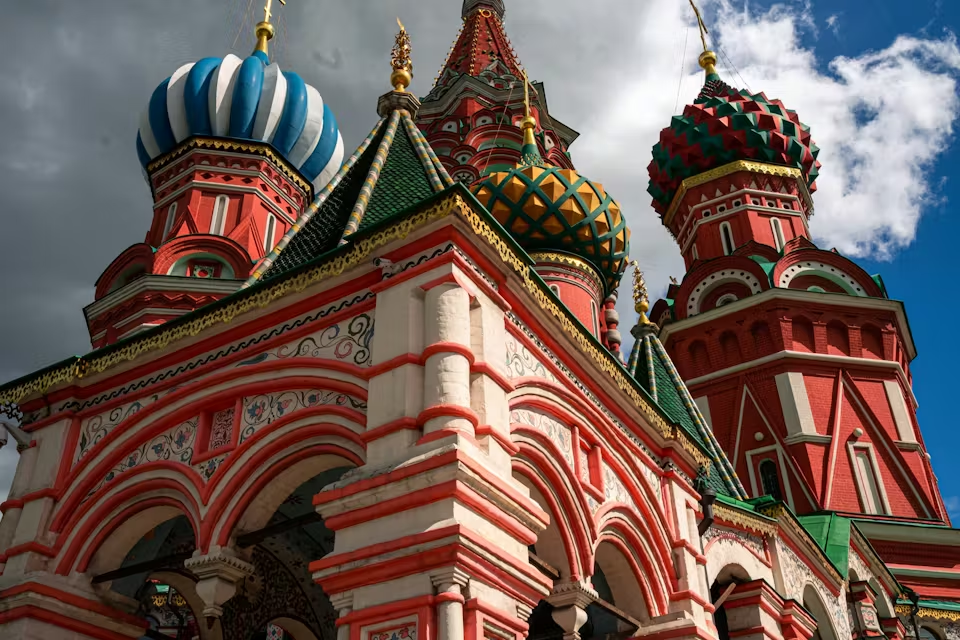
MBBS in Russia from Top Medical Universities Russia has been popular destination for International students for pursuing...

Undergraduate and graduate entry medicine in NEW ZEALAND , medical study tuition fees in New Zealand. Medical study (med...